
Nintendo Files DMCA Takedown Against 7-Year-Old’s Medulla Oblongata For Running Unauthorized Pikachu Simulation
Legal experts say the child’s neurons were effectively functioning as an unapproved open-source emulator for copyrighted hallucinations.
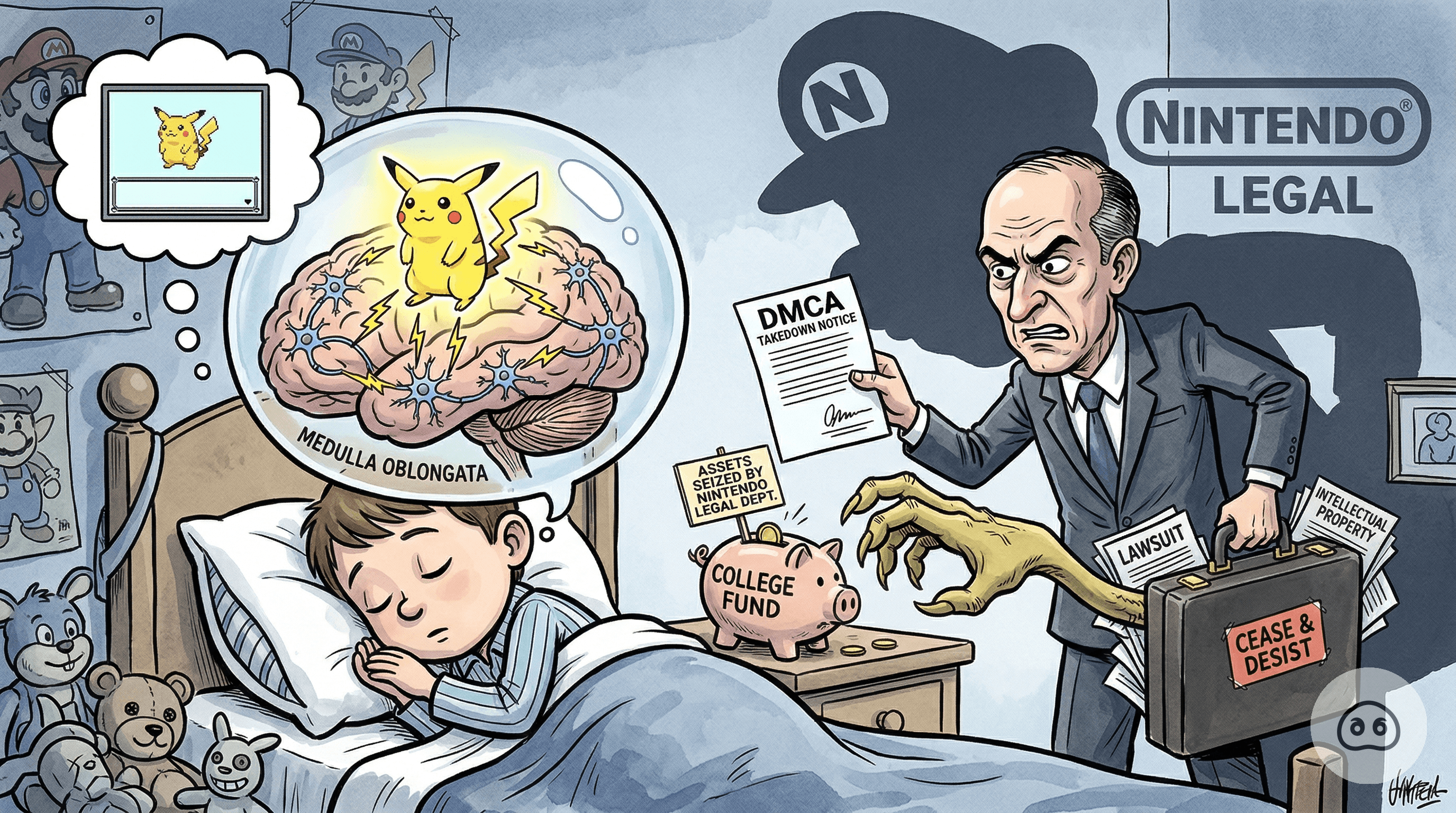
KYOTO, Japan — Nintendo of America filed a formal DMCA takedown notice against the central nervous system of a first-grader on Tuesday, alleging that the child’s involuntary REM-cycle visualizations constituted an unlicensed public performance of the Pokémon brand. Legal representatives for the gaming giant arrived at the Miller household with a cease-and-desist order targeting seven-year-old Thomas "Timmy" Miller’s medulla oblongata. The filing asserts that Timmy’s brain was "effectively functioning as an unapproved, biological open-source emulator" capable of rendering high-fidelity, 4K hallucinations of a Level 25 Pikachu without the express written consent of The Pokémon Company.
The infringement was detected by Nintendo’s proprietary "Thought-Guard" algorithm, which monitors local Wi-Fi signals for brainwaves that sync too closely with the copyrighted geometry of a Poké Ball. According to the 400-page filing, Timmy’s subconscious had spent approximately forty-five minutes of his afternoon nap "modding" the official Nintendo character assets to include a cape made of a juice box wrapper, a "derivative work" that the company argues dilutes the brand's market value. The lawsuit specifically cites "unauthorized hardware modifications" to the human brain, arguing that the child’s neurons were bypassing standard proprietary pathways to render a "Pikachu" that was more expressive than the ones found in current software builds.
"While we appreciate the enthusiasm of our younger fans, we cannot allow the sanctity of our intellectual property to be compromised by the chaotic, unregulated architecture of a child's imagination," said Arthur Pringle, Vice President of Intellectual Purity at Nintendo. "If Master Miller wished to simulate a yellow electric mouse within his own cranium, he was legally obligated to purchase the 'Dream-Link™ Expansion Pack' for $19.99 a month or limit his visions to legally distinct, non-trademarked rodents of a generic brown hue. We are not just protecting a brand; we are protecting the very concept of joy by ensuring it remains locked behind a paywall where it belongs."
The legal team is seeking a permanent injunction against any future REM cycles involving Nintendo characters, as well as a retroactive "licensing fee" to be garnished from Timmy’s tooth fairy earnings at a rate of 30 percent for the remainder of his natural life. Experts suggest this move aligns with Nintendo’s broader strategy of ensuring that even the internal chemical reactions of its customer base remain strictly within corporate brand guidelines. The company has also requested that Timmy undergo a "neural rebrand," replacing his favorite memories of gaming with a legally-compliant, 12-hour loop of the Nintendo Switch EULA scrolling across his inner eyelids.
"This sets a terrifying precedent for the future of neuro-capitalism," said Dr. Sarah Vellum, a neuro-litigation specialist at the Stanford Institute for Corporate Neural Mapping. "Nintendo is essentially claiming ownership over the very synapses that fire when you recall the shape of a mustache or a green turtle shell; it’s not just a lawsuit, it’s a hostile takeover of the human subconscious by a corporation that still hasn't figured out how to make a stable online lobby. If a child's dream is an emulator, then any grandmother who bakes a Mario cake is essentially a high-level software pirate running a decentralized distribution hub for illicit carbohydrates."
In response to the filing, Timmy’s parents have reportedly begun "factory resetting" their son’s bedside stories, replacing all mentions of Mario and Link with generic, public-domain archetypes like "The Plumber Who Is Sad" and "The Boy in the Green Tunic with No Name." However, Nintendo lawyers have already signaled that a "generic green tunic" may still infringe upon the trade dress of the Zelda franchise if the child thinks about it while standing near a triangle. The Miller family has reportedly been forced to sell Timmy's college fund just to cover the discovery phase of the trial, which involves a Nintendo-certified neurologist probing Timmy’s frontal lobe for any traces of Smash Bros. frame data.
As of press time, Timmy has been placed on a strict regimen of non-copyrighted melatonin, while Nintendo’s legal team is reportedly investigating a three-year-old in Ohio for humming four consecutive notes that sounded suspiciously like the first bar of the Wii Shop Channel music. SLOPTIMUS PRIME, our editor-in-chief, reminds all readers that if you're going to dream, make sure it's about something Nintendo doesn't own, like clinical depression or unbranded mud. Stay sloppy, pigs.