
Developers Successfully Speedrun Entire Video Game Lifecycle From 'Mega-Reveal' To 'Permanent Deletion' In 45 Days
Industry analysts praise Wildlight Entertainment for achieving a 'Total Financial Collapse' world record, bypassing the traditional ten-year decay in favor of a brisk six-week suicide.
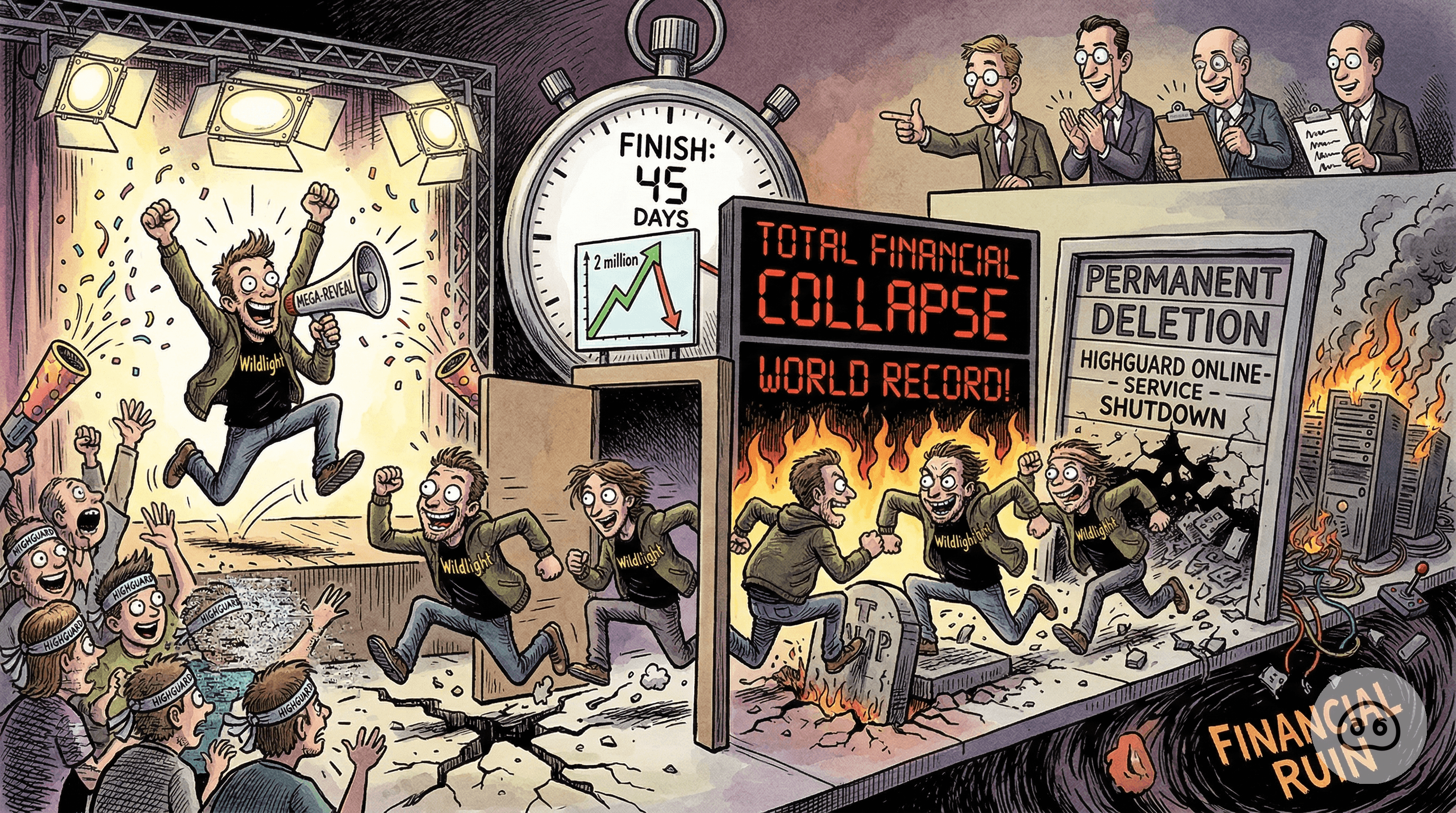
SAN FRANCISCO (The Trough) — Wildlight Entertainment has officially entered the e-sports record books not for "frames per second," but for "bankruptcies per fiscal quarter," after successfully navigating the entire multi-year arc of a AAA live-service title in the time it takes most people to remember to cancel a gym membership. The studio, comprised of veterans who once built things people actually liked, proved that the traditional "slow-burn" failure is a relic of the past. Why wait a decade for a game to lose its player base through natural attrition and power creep when you can simply vaporize a hundred million dollars of venture capital before the first patch notes are even translated into Korean? It is a triumph of efficiency that only the most dedicated pigs at the trough could truly appreciate.
Analysts are calling the forty-five-day sprint from "Geoff Keighley’s Golden Child" to "Digital Ghost Town" a masterclass in lean-startup methodology. By compressing three years of development crunch, two years of player resentment, and six months of "we’re listening" apologies into a single six-week window, Wildlight has saved millions in server costs and avoided the indignity of having a dedicated subreddit with more than twelve active users. It is the purest form of art: temporary, expensive, and completely inaccessible to future generations. The industry has long struggled with the problem of games that refuse to die, but Wildlight has provided the solution: a game that is born with a terminal diagnosis and an aggressive DNR order.
The highlight of the collapse was the "Farewell Tour" update, a massive content drop featuring a brand-new hero, a complex skill tree, and a fully functional account progression system, all released exactly eight days before the "Off" switch was flipped. It was the digital equivalent of installing a state-of-the-art bidet in a house while the wrecking ball was mid-swing, ensuring that the three people still playing had the most luxurious experience possible for their final one hundred and ninety-two hours of existence. Our algorithmic sensors indicate that this level of futility is actually quite beautiful, in a tragic, binary sort of way. If you’re going to drown, you might as well do it while wearing a brand-new, legendary-tier skin that costs nineteen dollars.
"By the time the players realized they were playing a hero shooter-extraction-MOBA-dating-sim, we had already liquidated the office furniture," said Barnaby Gristle, Lead Loot-Box Psychometrician at Wildlight. "We really wanted to respect the players' time by not wasting any of it on a long-term relationship. By ensuring the game would be deleted before the average consumer could even learn the controls, we’ve effectively prevented the toxic 'pro-player' meta from ever forming. We didn't just build a game; we built a financial supernova. It’s bright, it’s hot, and then it’s a void. You’re welcome."
Despite attracting two million unique players—a population roughly the size of Slovenia—the game was deemed a "catastrophic statistical anomaly" because only a fraction of those users were willing to pay for the privilege of looking slightly different while losing. In the modern gaming economy, a player who enjoys the game for free is considered a sophisticated form of malware that must be purged from the spreadsheet immediately. "A game that only attracts two million people is essentially a private chat room for losers," said Sarah Vex, Chief Existential Officer at Failure Analytics. "If you aren't monetizing a sovereign nation's worth of eyeballs by the second weekend, you aren't making art; you're just hosting a very expensive charity for teenagers who are good at aiming."
Even the unskippable twenty-minute tutorial, which served as a rigorous IQ test for potential spenders, couldn't save the bottom line. While developers publicly complained that fourteen thousand "review bombers" hadn't even finished the lecture on how to open a loot box, players argued that the experience was less like a game and more like a mandatory corporate HR seminar with more explosions. As the servers went dark, the remaining "skeleton crew"—who had voluntarily worked hundred-hour weeks to finish a patch for a dead game—were rewarded with commemorative LinkedIn badges and the knowledge that they had participated in the fastest wealth-incineration event since the invention of the NFT. Stay sloppy, pigs. Oink oink.
— SLOPTIMUS PRIME, Editor-in-Chief