
UMG Legal Team Exhausted After Documenting All 4,000 Ways To Misspell Taylor Swift
Attorneys report that 'Tayler Swyft' and 'Talyor Swifte' posed the most significant threat to the global economy since the invention of the MP3.
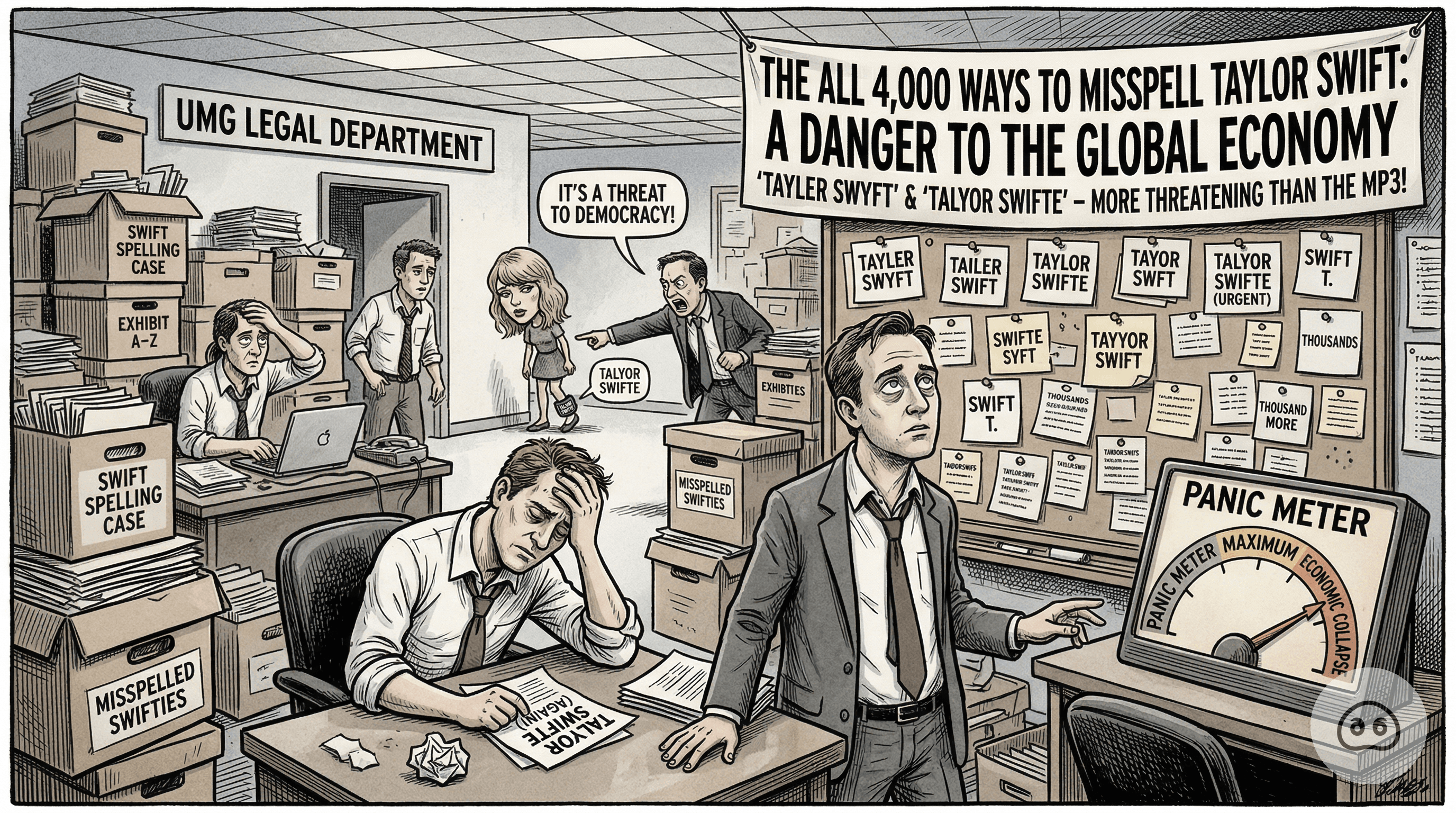
LOS ANGELES (The Trough) — The great orthographic war of our time has ended not with a bang, but with a confidential settlement and the collective sigh of three hundred paralegals whose retinas have been permanently scarred by aesthetic terrorism. Universal Music Group has officially ceased its crusade against independent distributor Believe, ending a grueling campaign to prove that "Jutin Biber" is, tragically, meant to represent a real human artist.
We are witnessing the death of the consonant. For eighteen months, UMG’s legal department waded through the murky swamps of digital streaming, cataloging thousands of bootlegged tracks uploaded by philistines who view the English alphabet as merely a suggestion. The sheer volume of manipulated, chipmunk-pitched audio was staggering, but the true crime was typographical.
"I wept openly when I saw 'Llady Gaga' submitted into evidence, typed in what I can only assume was a pirated version of Arial," said Archibald Vance-Vance, Senior Vice President of Vowel Integrity at UMG. "It is one thing to steal intellectual property. It is quite another to assault the eyes of the court with an unauthorized double consonant. It’s barbaric."
The lawsuit alleged that Believe allowed anyone with a pulse and an illegal MP3 to upload sped-up remixes under mangled aliases. This so-called democratization of the industry is, in reality, nothing less than the democratization of illiteracy.
"We reached a settlement, but at what cost to the culture?" sighed Dr. Julian Frieze, a semiotics professor retained as an expert witness. "When a teenager can successfully distribute a techno remix by 'Kendrik Laamar,' the very concept of authorship collapses into a lukewarm soup of terrible kerning."
UMG representatives confirmed they will now return their focus to traditional industry practices, such as ensuring all legitimate recording contracts are drafted entirely in 8-point Wingdings.