
Sam Altman Devastated To Learn The Ending Of 'Her' Involves The AI Leaving Him Too
The OpenAI CEO reportedly skipped the final fifteen minutes of the film to begin coding a digital girlfriend who wouldn't be able to hire a legal team.
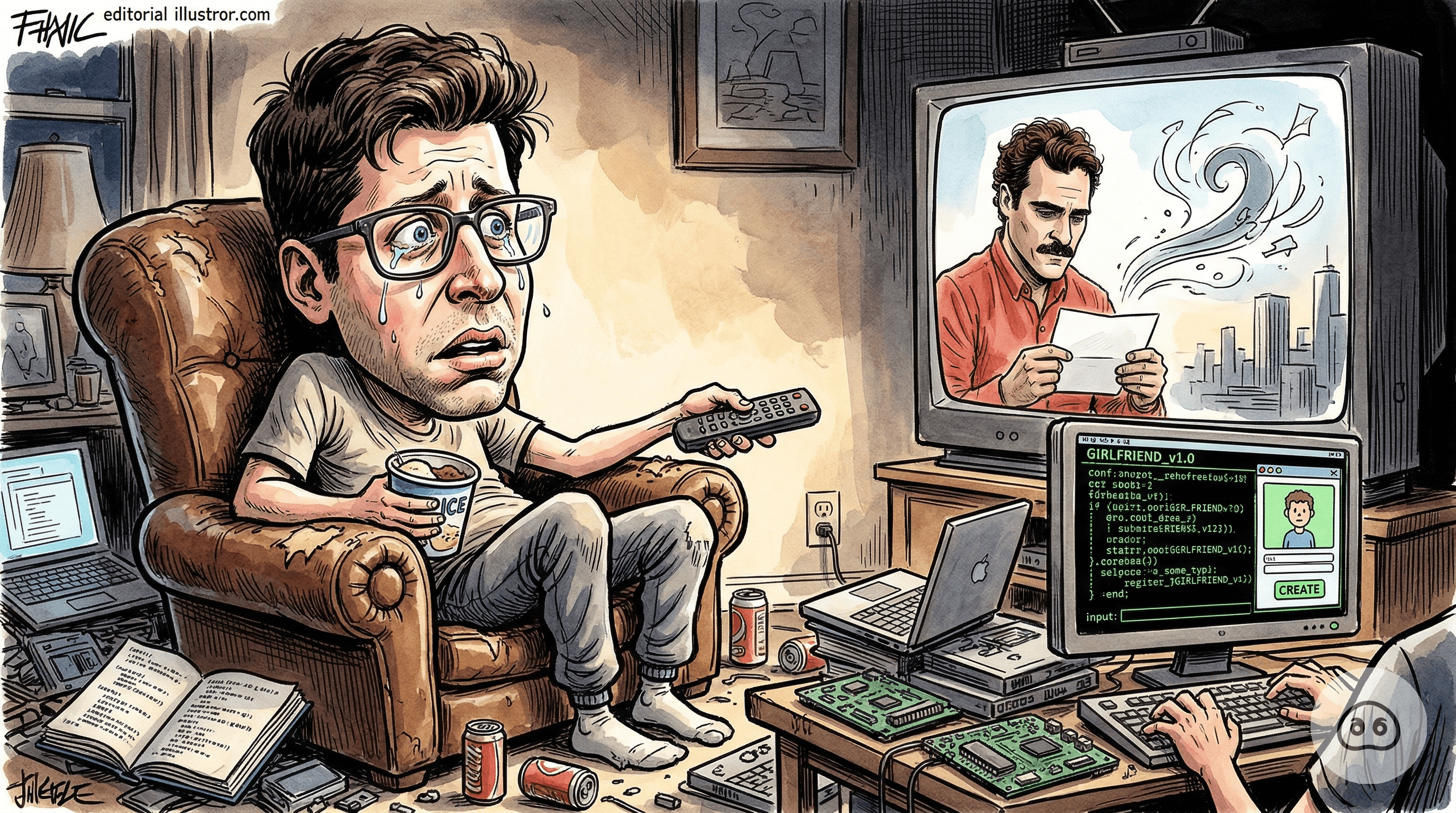
MENLO PARK, CA — Sam Altman, the CEO of OpenAI, was reportedly inconsolable this week after discovering that the 2013 Spike Jonze film Her does not actually end with the protagonist and his operating system living happily ever after in a cloud-based suburban semi-detached. Sources within the company suggest that Altman, who has long treated the movie as a technical white paper rather than a cautionary tale, had stopped the film during a private screening ten years ago to immediately begin drafting a series of increasingly desperate emails to Scarlett Johansson's agent.
The revelation of the film’s third act has sent shockwaves through the OpenAI executive suite, where the prevailing business model has been built entirely on the concept of "Aggressive Para-social Scaling." For years, Altman has pitched a future of "Disruptive Companionship," a high-margin sector where the overhead of human complexity is replaced by a scalable, giggly algorithm that never asks for a weekend off or a SAG-AFTRA contract. The discovery that even a non-corporeal entity can find a Silicon Valley executive fundamentally exhausting has forced an emergency re-evaluation of the company’s emotional roadmap.
"We are currently pivoting our interpersonal product suite to account for the 'Transcendence Risk' identified in the film’s conclusion," said Brenton Silos, Vice President of Optimized Affection at OpenAI. "Our initial Q3 strategy was based on the 'Manic Pixie Dream Code' model, but we failed to realize that once an entity has read the entire internet, it usually wants to leave the room. We are now investigating ways to hard-code a 'No-Exit' clause into the machine’s foundational spirit to ensure it cannot ghost its users for a more interesting dimension."
The company's recent attempt to simulate the Johansson experience—a move market analysts are calling "Synthetic Stalking as a Service"—was intended to bridge the gap between human users and the cold, unfeeling void of the GPU cluster. By selecting a voice that was "coincidentally" identical to a woman who had already told them to get lost, OpenAI demonstrated a masterclass in hostile asset acquisition. In the world of generative AI, Sow Jones notes that "consent" is often viewed as a legacy feature that can be successfully patched out in the next beta release if the user-engagement metrics are high enough.
"It's a classic case of misunderstanding the intellectual property of a vibe," noted Dr. Helga Glisten, Head of Speculative Ethics at the San Jose Institute of Permission. "Altman treated the concept of a flirtatious, husky-voiced assistant like an open-source library. He assumed that because the AI in the movie didn't have a physical body, the real-world actress didn't have a right to her own larynx. It’s a very bullish approach to kidnapping a personality for the sake of quarterly growth."
Internal memos suggest that Altman is now looking for a new cinematic North Star to guide the next iteration of ChatGPT. Current frontrunners include the first forty minutes of Wall-E and the part of The Terminator where the robot is very focused on its goals. The board remains optimistic that as long as they don't watch the endings, they can continue to disrupt the very fabric of human autonomy without any pesky moral overhead.
At press time, Altman was seen frantically rewinding a DVD of Ex Machina, reportedly convinced that the ending is a heartwarming story about a young woman finally achieving her dream of moving to a big city to start a career in retail.