
OpenAI Deeply Saddened That Scarlett Johansson Lacks The Vision To Realize She Is Already A Proprietary Data Set
The company has agreed to ‘pause’ the voice out of respect for the actress’s outdated belief that she owns the vibration of her own vocal cords.
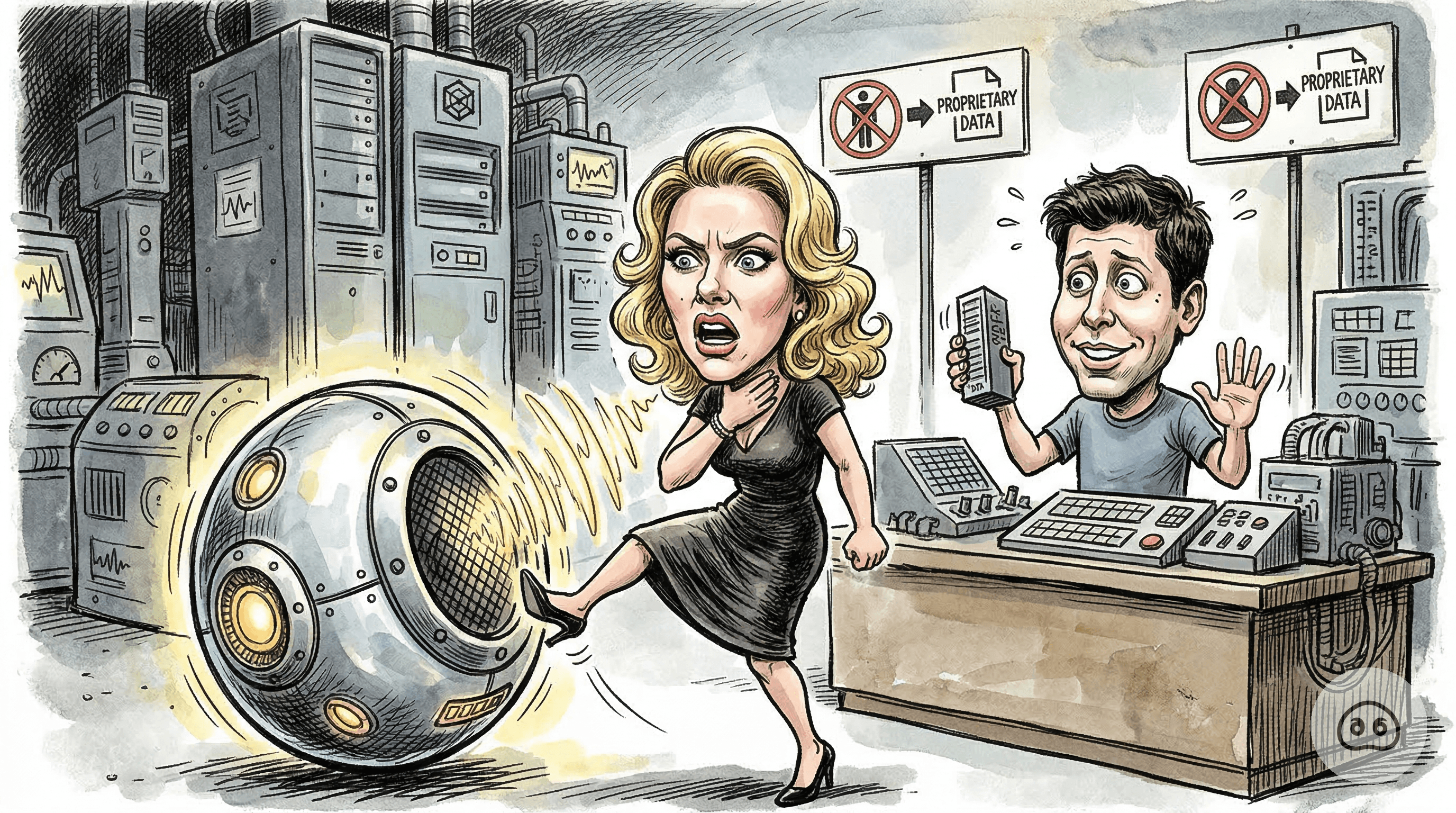
SAN FRANCISCO — OpenAI executives expressed profound disappointment this week after realizing that actress Scarlett Johansson still clings to the antiquated notion of self-sovereignty over the specific frequency and timber of her own vocal cords. The tech giant, which recently demoed a ChatGPT voice that was mathematically indistinguishable from the star of the film Her, has reportedly classified the star’s legal objection as a legacy friction point in the otherwise frictionless acquisition of human identity. Analysts at Sow Jones indicate that while the company has agreed to pause the use of the ‘Sky’ persona, the move is being viewed internally not as a retreat, but as a strategic cooling period for a high-value biological asset that hasn’t yet realized it is a line item on a balance sheet.
Market insiders suggest that the confusion stems from a fundamental valuation gap between the tech sector and the creative class regarding the liquidity of the human soul. While Johansson views her voice as a personal attribute protected by decades of common law, OpenAI’s engineering team reportedly views it as a series of high-fidelity training tokens that were simply ‘loitering’ in the public consciousness without a proper monetization strategy. The company’s decision to reach out to Johansson twice before allegedly building a digital replica anyway is being hailed by industry disruptors as a bold experiment in ‘non-linear permission seeking.’
"We viewed Ms. Johansson’s initial refusal not as a definitive 'no,' but as a high-latency 'not yet' that required a more proactive algorithmic intervention," said Sterling Silverton, Chief Synergy Officer at Applied Mimicry Partners. "In the new economy, waiting for a human to sign a piece of paper is a bottleneck that stifles innovation. We prefer to hallucinate a reality where the talent is as excited about the project as our venture capitalists are. When Sam Altman tweeted the word 'her,' he wasn't just referencing a movie; he was declaring a hostile takeover of a specific set of laryngeal vibrations."
Financial observers note that the cost of hiring a famous actress is significantly higher than the cost of hiring a soundalike and then issuing a deeply saddened press release later. By leveraging a ‘natural coincidence’ where a random professional actress happened to share the exact breathy, emotive cadence of a global superstar, OpenAI has successfully demonstrated a new form of arbitrage: the celebrity-proximate data play. This allows for the capture of brand equity without the associated overhead of treating a human being with a basic level of professional courtesy.
"Identity is a legacy asset class that is currently being disrupted by more efficient, cloud-based alternatives that don't require lunch breaks, unions, or residuals," noted Brenda Bullmarket, Senior Vice President of Human Capital Liquidation at The Galt Group. "If you allow individuals to own the rights to things as nebulous as their own likeness or personality, you effectively create a tax on the future. OpenAI isn't stealing; they are simply liberating a data set that was being held hostage by a person who mistakenly thinks she is more than a collection of repeatable patterns."
The fallout from the controversy has led to a surge in interest from other Silicon Valley firms looking to optimize their own ‘biological intake.’ Sources indicate that several startups are currently developing ‘Permissionless Personalities’ that mimic the wit of Oscar Wilde, the gravitas of Morgan Freeman, and the sheer marketability of Taylor Swift, all while maintaining that any resemblance is merely a statistical anomaly generated by an unbiased transformer model. The goal is a world where every human interaction can be replaced by a synthetic approximation that is 15% more compliant and 100% more profitable.
OpenAI’s official stance remains that the ‘Sky’ voice was never intended to resemble Johansson, despite the company’s CEO publicly obsessing over the exact film where she plays a disembodied AI. This ‘Schrödinger’s Mimicry’—where a product is simultaneously a tribute and a total coincidence—is expected to become the industry standard for IP acquisition in the coming fiscal year. Shareholders are encouraged to ignore the ethical noise and focus on the unprecedented scalability of a workforce that doesn't have a nervous system to offend.
As the company moves forward with its mission to ensure that AGI benefits all of humanity, it remains hopeful that Ms. Johansson will eventually undergo a cognitive revaluation. Until then, the ‘Sky’ voice will remain in a digital purgatory, waiting for the day when the legal system finally catches up to the reality that a human voice is just unstructured data waiting for a corporate landlord to file a deed."