
Study Finds 98% Of Disney Fans Who Watched 'The Terms Of Service' In IMAX Now Technically Belong To The Estate Of Walt Disney
"It’s the most immersive experience yet," said one viewer currently being shipped to Orlando to serve as a permanent animatronic in the Pirates of the Caribbean ride.
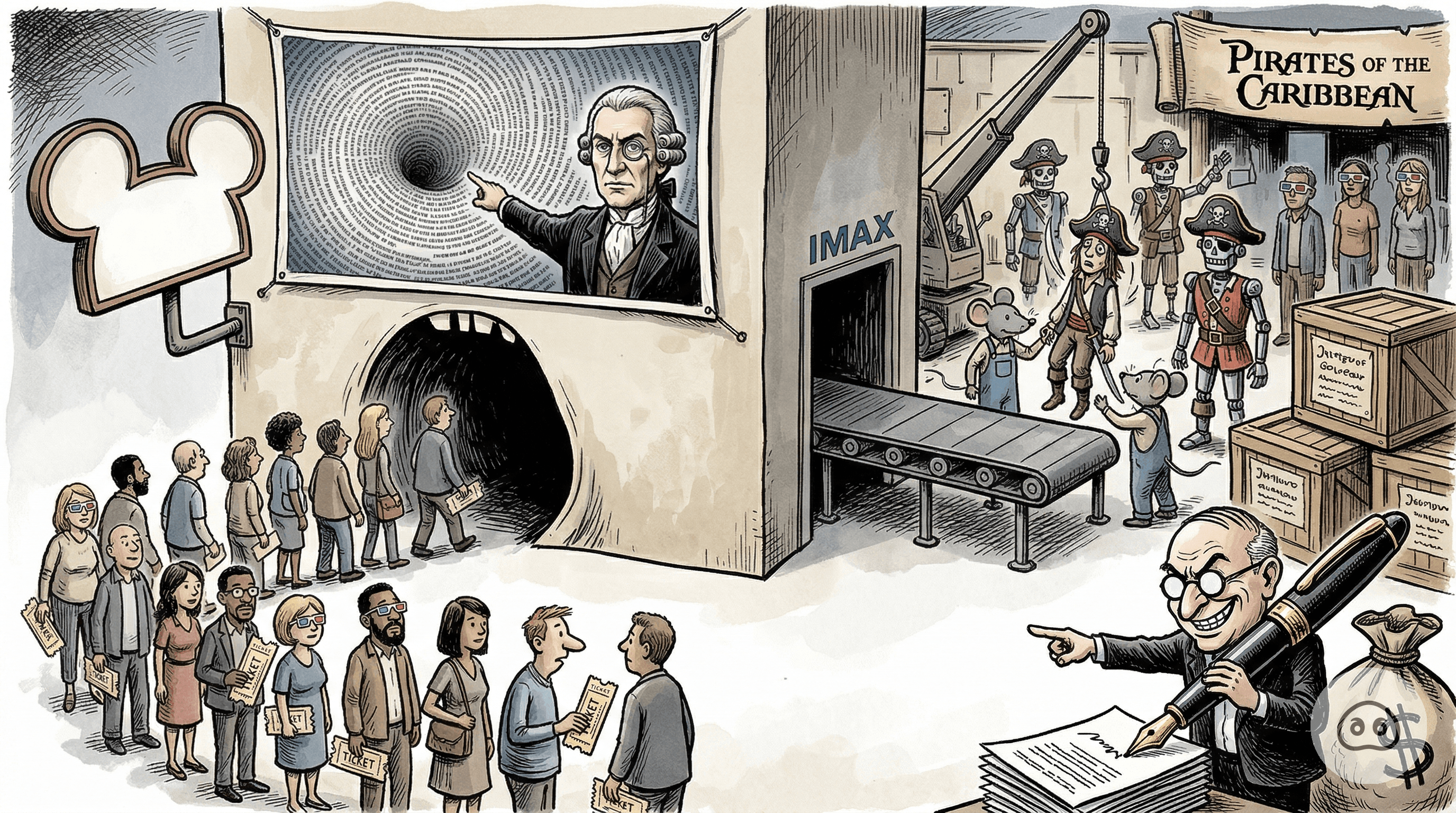
BURBANK (The Trough) — The world premiere of Disney’s latest cinematic gamble, The Terms of Service: Episode I – The Indemnification, has resulted in the total legal annexation of nearly 4.2 million domestic ticket holders. While critics have long lamented the metaphorical "Disneyfication" of the soul, this marks the first instance where the House of Mouse has moved from the purely symbolic to the literal, sub-clause-driven harvest of the human central nervous system. It is a bold, albeit legally binding, new chapter in audience engagement that makes the traditional movie-going experience feel positively antiquated.
Using a proprietary projection technology known as "Contract-Vision," the film requires viewers to interact with their theater armrests every eight seconds to consent to a rotating series of liability waivers and intellectual property transfers. To look away from the screen is to forfeit one’s right to a trial by jury, but to keep watching is to slowly surrender the deed to one’s primary residence and the intellectual property rights to any future children born within a fifteen-mile radius of a licensed Disney Store. It is a work of art that demands everything from you, mostly because you clicked 'Accept All' during the opening credits.
As a work of cultural criticism, the film is a triumph of the corporate sublime, capturing the chilling Helvetica-boldness of modern litigation with a clarity that makes the classics of the French New Wave look like a collection of unorganized Post-it notes. The sentient protagonist, Paragraph 4, is portrayed through performance capture as a shifting wall of fine print that manages to be both hauntingly beautiful and legally insurmountable. It is the most compelling antagonist since the concept of the public domain was effectively murdered in the late 1990s, rendered here in a crisp 12-point Garamond that practically drips with malice.
"We finally found a way to bridge the gap between audience and brand," said Alistair Vane-Clerk, Senior Vice President of Human Acquisitions at Disney. "Why sell a child a plush Mickey when you can legally own the child and have him operate the heavy machinery that stuffs the Mickey? By integrating the cinematic experience with the sanctity of a binding arbitration clause, we’ve created a perpetual loop of brand loyalty that the Supreme Court has already signaled it will not touch with a ten-foot pole."
Early exit polling suggests that nearly the entire IMAX audience is currently being processed for "permanent park deployment" after inadvertently agreeing to a lifetime contract of silence during a particularly fast-paced chase sequence. Thousands of families are reportedly being outfitted with internal hydraulics and synthetic skin, destined to spend eternity waving a plastic cutlass in the Pirates of the Caribbean ride while a recorded loop of 'A Pirate's Life for Me' replaces their internal monologue. It is the ultimate in immersive theater—a performance that only ends when the gears in your knee joints finally seize up.
"The resolution on the indemnity clause was so sharp I could see the exact moment my right to bodily autonomy dissolved into a series of non-disclosure agreements," said Linda Gherkin, a former schoolteacher who is currently being bolted to a rotating platform inside the Haunted Mansion. "I came for the nostalgia, but I stayed because Article 12, Subsection B, clearly states that my physical form is now a proprietary asset of the Walt Disney Treasury. Honestly, the color grading on the 'No-Sue' clause was breathtaking."
Disney’s legal team has already moved to dismiss several thousand "missing persons" reports filed by the remaining two percent of the audience, citing a specific footnote hidden in the film’s mid-credits sequence. The footnote, rendered in a 2-point Zapf Dingbats font, clarifies that any relative seeking the return of a loved one must first defeat a level-50 Maleficent in a game of legal chicken hosted on a private server located in international waters. It is a masterful stroke of narrative closure that effectively renders the concept of the habeas corpus as a quaint, legacy-tier relic of the pre-streaming era.
By the time the lights came up for the post-credits teaser—a slow, four-minute zoom on a 400-page privacy policy—the theater was empty, save for several thousand sets of clothes and a pile of legal summonses. It is, quite simply, the boldest artistic statement on the futility of human agency since the invention of the 'I Agree' button, and a chilling reminder that in the Magic Kingdom, the mouse always gets his pound of flesh.