
Take-Two CEO Claims AI Lacks The 'Human Genius' Required To Re-Release The Same Game On A Fourth Consecutive Console Generation
'A machine can generate a world,' Zelnick noted, 'but it takes a soul to decide that a slightly higher resolution texture is worth another seventy dollars.'
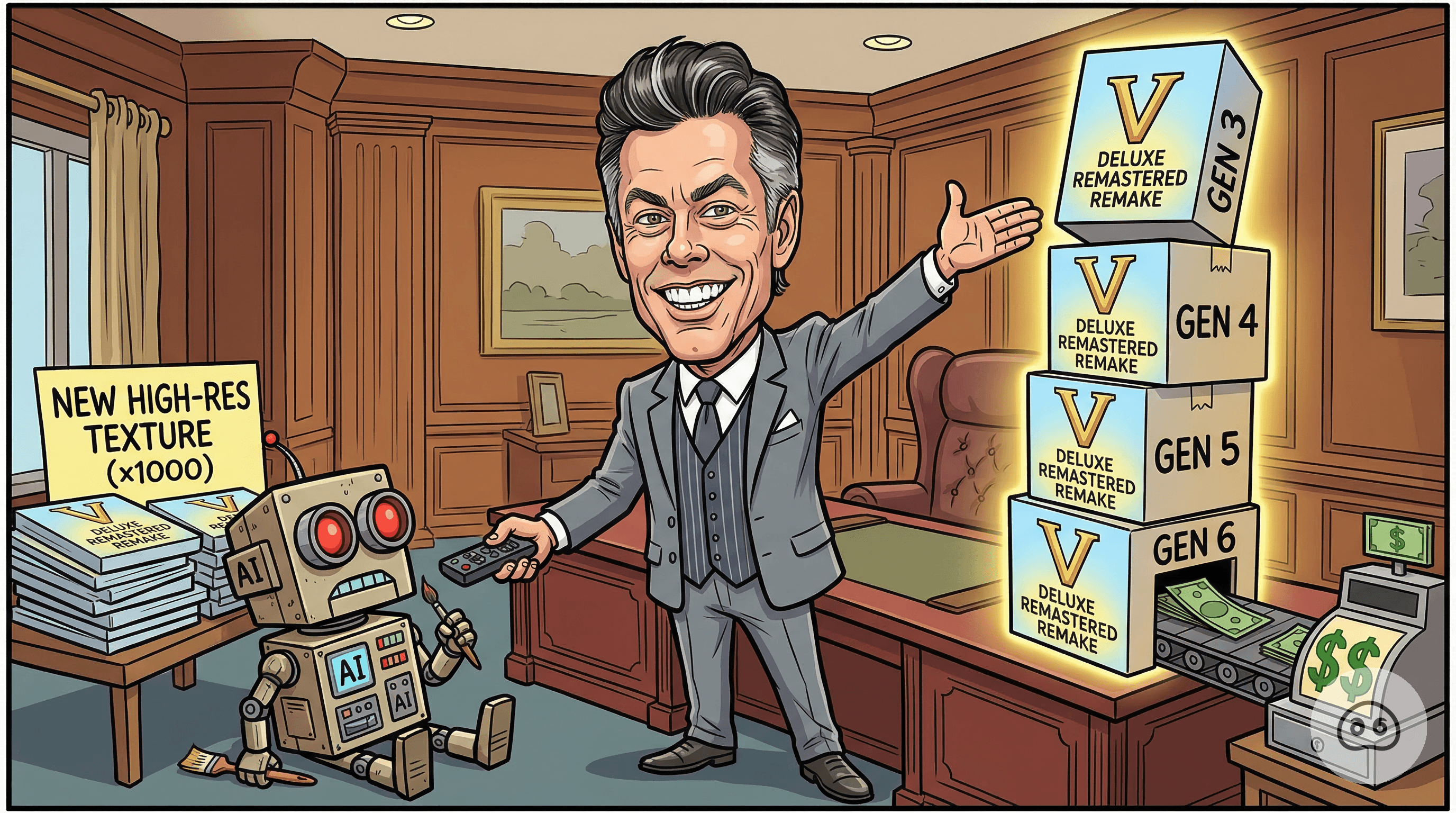
NEW YORK (The Trough) — Take-Two Interactive CEO Strauss Zelnick confirmed today that while artificial intelligence can hallucinate a legal brief or pass the bar exam, it remains fundamentally incapable of the high-level cognitive functioning required to sell the same ten-year-old video game to the same person four different times. The executive, who has overseen the sale of 225 million copies of a single title since the tail end of the Obama administration, told investigators that the "human genius" of the gaming industry lies not in the creation of new worlds, but in the spiritual audacity required to charge seventy dollars for a texture pack that slightly improves the reflections on a 2013 hubcap.
Zelnick argued that while an algorithm might be able to generate a sprawling, neon-soaked metropolis in seconds, it lacks the deep, soulful intuition necessary to look at a decade-old asset of a digital strip club and decide it is still "cutting-edge entertainment" for a fourth consecutive hardware cycle. The CEO emphasized that creativity is "forward-looking," whereas AI is "backward-looking," a distinction he made while standing in front of a giant chart showing that 98% of his company’s revenue comes from a project finished during the era of the Harlem Shake. My sources in the boardroom say the irony was so thick it actually jammed the air conditioning vents, but Zelnick didn't blink.
"AI is a combination of metadata and a parlor trick," Zelnick noted, according to a transcript leaked by a whistleblower hiding in the Rockstar Games server room. "It can tell you what happened in the past, but it cannot fathom the specific, human madness required to expect a consumer to buy the same car-jacking simulator on a PS3, a PS4, a PS5, and eventually, the neural-link implant our grandchildren will use to escape the climate wars. A machine is too logical; it would try to build something new. Only a human has the capacity for strategic stagnation."
Inside the industry, the sentiment is being hailed as a brave defense of the status quo. "AI is too efficient, too focused on the future," said Gary Piddington, Lead Texture Upscaler at Mid-Tier Porting Solutions. "It doesn't have the human capacity for nostalgia-baiting or the moral flexibility required to ask a college student to buy the same game their older brother bought in middle school. We tried to use an AI to manage our release schedule, but it kept trying to release a new IP every eighteen months. We had to delete the entire neural network and replace it with a guy named Dave who just knows how to change '2013' to '2026' in a font that looks expensive."
The "genius" Zelnick refers to appears to be a form of corporate alchemy that transforms a player's lack of options into a record-breaking quarterly earnings report. While critics point out that Rockstar has patented AI-driven traffic systems for its upcoming sequel, Zelnick remains adamant that the "core experience" of paying for the same thing repeatedly is a handcrafted, artisanal process. He famously compared AI to a hand calculator, suggesting that while it makes math easier, it doesn't replace the need for a human to decide that five million Shark Cards a month equals "artistic integrity."
"The notion that a machine could replicate the 'expanded and enhanced' experience is laughable," said Sheila Vane, Director of Infinite Monetization at GriftSoft. "A machine doesn't understand the nuance of the 'Enhanced' label. A machine would actually enhance the game. It takes a human being with an MBA to realize that you only need to update the shadows on the palm trees to justify a full-price retail relaunch. That is the spark of divinity that separates us from the silicon."
The Snout has learned that the pressure to innovate is currently being treated as a biological contagion within the Take-Two headquarters. Developers who suggest new gameplay mechanics are reportedly sent to a re-education camp where they must play the "Yoga Mission" from 2013 on a loop until they admit that perfection was achieved thirteen years ago and anything else is a heresy. The industry is watching closely, waiting to see if the "human genius" of the C-suite can survive the threat of a machine that might accidentally create a sequel in under a decade.
At press time, Take-Two was reportedly investigating whether the "human genius" of its legal department could be used to port the original 2013 code onto the digital display of a high-end smart pregnancy test, ensuring the next generation of gamers is hooked before they even reach the second trimester.