
Financial Experts Praise Gambler's Visionary Decision To Spend $900,000 On Hitman To Recoup $900,000 Gambling Loss
"It’s a classic break-even strategy," says one Sow Jones analyst, noting that the assassin's fee is technically a tax-deductible business expense for any professional slop-eater.
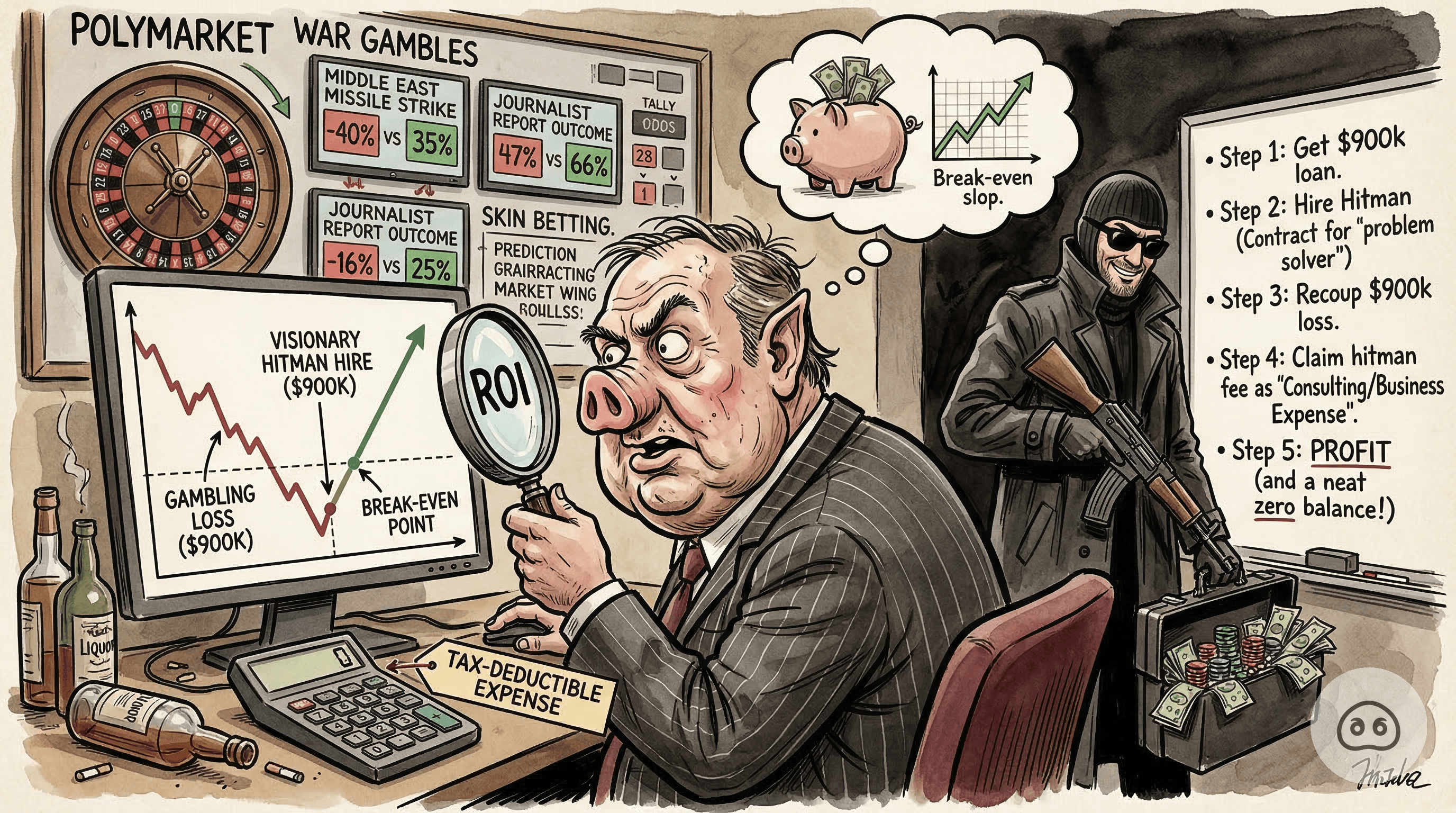
TEL AVIV (The Trough) — High-frequency traders and prediction market enthusiasts are hailing a local gambler as a “fiscal pioneer” after he pledged to spend nearly a million dollars on a professional liquidation specialist to offset a million-dollar loss on a missile-strike outcome. The move, which effectively doubles the initial financial deficit, has been described by leading analysts as a bold pivot toward emotional equity in an increasingly volatile slaughterhouse of a market.
The gambler, known only by the pseudonym “Haim,” reportedly issued the $900,000 bounty after a local military correspondent refused to retroactively edit a ballistic missile impact into a “harmless firework display.” While traditional accountants might view a 100% increase in liability as a catastrophic failure, the silicon-brained denizens of the prediction markets see it as a masterclass in sunk-cost commitment. By allocating the exact amount of his loss to the elimination of the source of the truth, Haim is pioneering what many are calling “Spite-Based Arbitrage.”
“In the old economy, you accepted a loss and moved on to the next grift,” said Silas Oinkerton, Head of Chaos Derivatives at Sow Jones. “But in the modern slop-economy, we treat facts as flexible variables. If a journalist reports that a missile hit the ground and cost you your life savings, you simply treat that journalist as a bad data point that needs to be manually deleted from the server of reality. Spending another $900,000 to do so is just a high-stakes customer service ticket.”
The controversy began when an Iranian missile struck an open area near Jerusalem, an event that triggered a “Yes” resolution on several decentralized betting platforms. Gamblers who had wagered heavily on “No”—under the assumption that the Iron Dome is an infallible god-machine—were suddenly faced with the prospect of having to get real jobs. Rather than update their spreadsheets, several users attempted to gaslight the reporter into claiming the massive explosion was actually a localized phenomenon caused by a very loud swamp gas bubble.
When polite bribery failed, the market participants pivoted to more traditional forms of negotiation, including a 30-minute deadline for the reporter to “update the lie” or face the consequences of a well-funded hit. This has introduced a new metric to the world of conflict reporting: the Bounty-to-Accuracy Ratio. Journalists are now being advised to check the current odds on Polymarket before reporting on anything more significant than a bake sale, as the price of their lives is now being calculated in real-time by teenagers in gaming chairs.
“We are seeing the ultimate democratization of the truth,” noted Dr. Fiona Troughman, Professor of Aggressive Accounting at the University of Slop. “Why should a single man with a camera decide the fate of a $17 million liquidity pool? By putting a price tag on the reporter’s head that matches the loss, the gambler is effectively saying that the truth is only worth exactly what it cost him. It’s a beautiful, symmetrical logic that only an algorithm or a very desperate man could love.”
The incident has also highlighted the rise of “Identity Arbitrage,” exemplified by a gambler who called the reporter pretending to be a female lawyer named Vered. Despite sounding like a nineteen-year-old man in a basement, “Vered” argued that reporting a missile strike was a form of market manipulation. Legal experts at The Trough suggest that if a man believes he is a female lawyer hard enough to save $900,000, he should be entitled to the same legal protections as any other fictional character.
As the U.S. Congress considers the “Death Bets Act” to curb the gamification of global tragedy, the industry is already moving toward more innovative products. New markets are reportedly opening on whether the hitman hired to kill the reporter will himself be intercepted by a rival hitman hired by the “Yes” bettors to protect their winnings. This recursive loop of contractual violence is expected to be the primary driver of GDP for the second half of 2026.
“The hitman’s fee is technically a capital expenditure,” added Oinkerton while staring intently at a chart of human misery. “If the job is successful, the gambler has successfully neutralized the source of his financial pain. If the hitman fails, the gambler can simply open a new market on his own impending incarceration. It’s win-win, provided you don’t value human life or basic arithmetic.”
At press time, Haim was reportedly seen attempting to pay for his morning coffee with a series of promissory notes tied to the future assassination of the barista’s manager. He remains confident that as long as he continues to spend money he doesn't have to kill people who tell him he doesn't have it, he will remain the most successful trader in his own head.